Transition matrix
A compact view of where observations move between two ordered states.
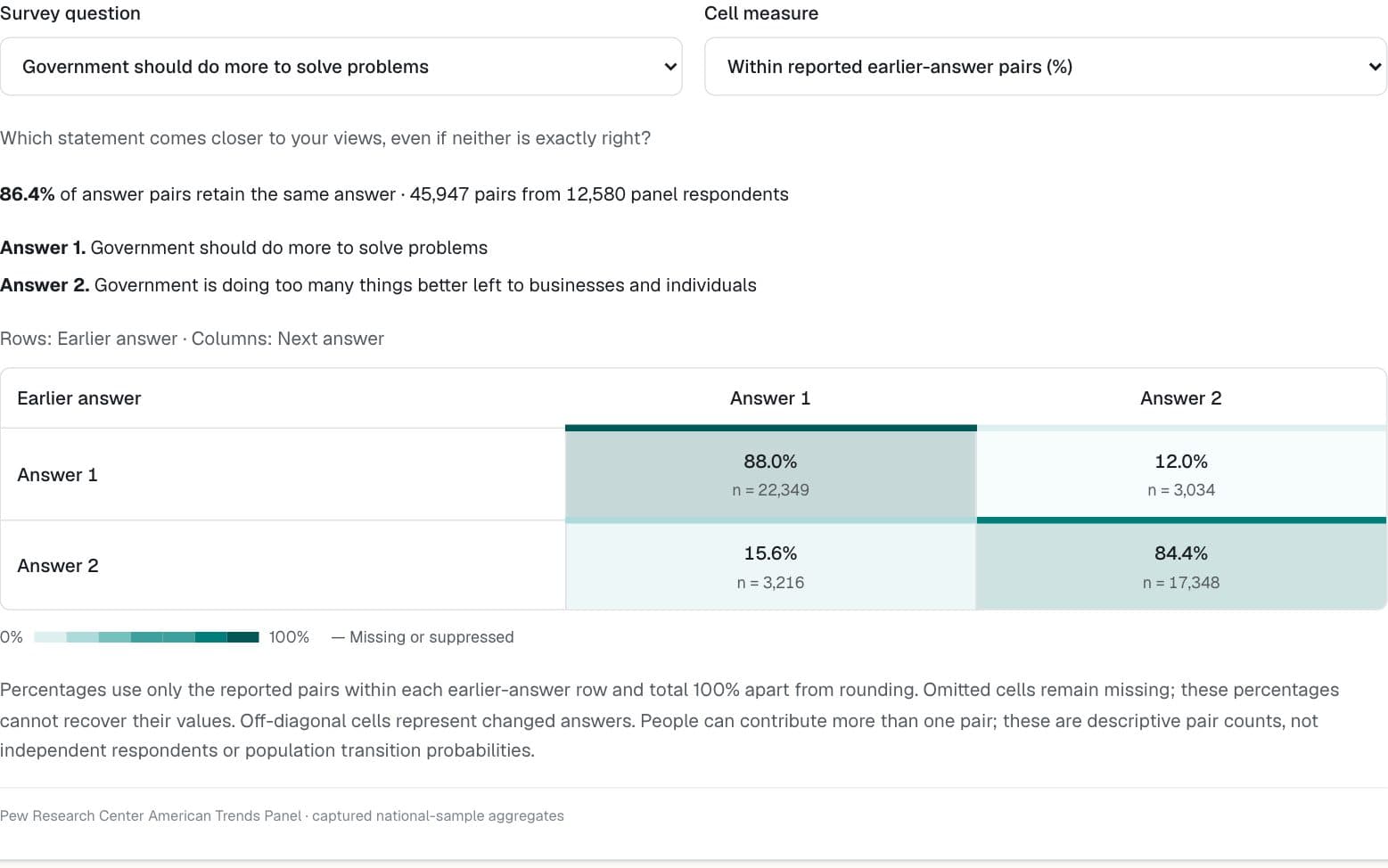
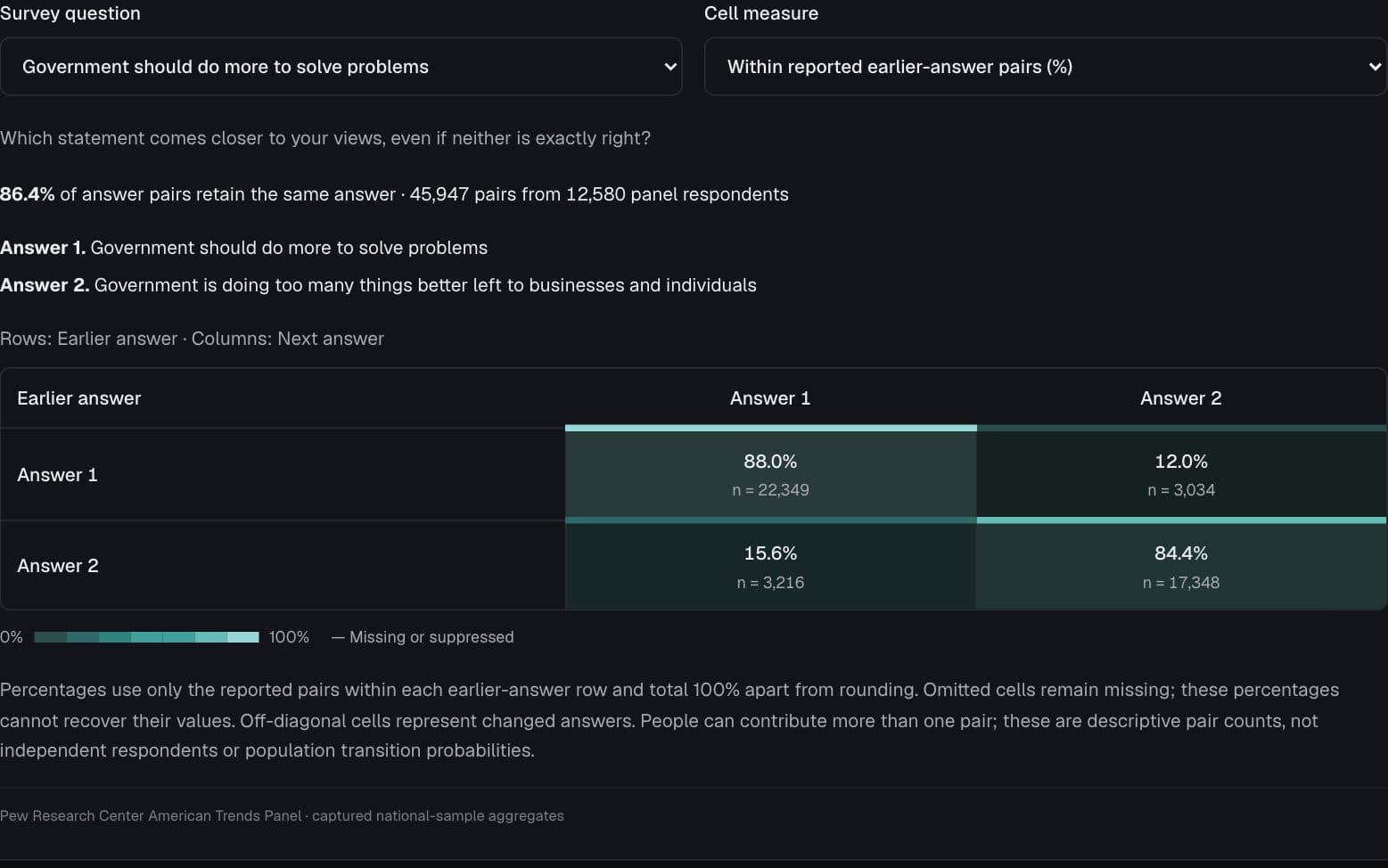
Which statement comes closer to your views, even if neither is exactly right?
86.4% of answer pairs retain the same answer · 45,947 pairs from 12,580 panel respondents
- Answer 1. Government should do more to solve problems
- Answer 2. Government is doing too many things better left to businesses and individuals
Rows: Earlier answer · Columns: Next answer
| Earlier answer | Answer 1 | Answer 2 |
|---|---|---|
| Answer 1 | 88.0%n = 22,349 | 12.0%n = 3,034 |
| Answer 2 | 15.6%n = 3,216 | 84.4%n = 17,348 |
0%
100%— Missing or suppressed
Percentages use only the reported pairs within each earlier-answer row and total 100% apart from rounding. Omitted cells remain missing; these percentages cannot recover their values. Off-diagonal cells represent changed answers. People can contribute more than one pair; these are descriptive pair counts, not independent respondents or population transition probabilities.
Pew Research Center American Trends Panel · captured national-sample aggregates
Preview
How to read it
Read across a row from an earlier answer to the next answer. The diagonal retains the same answer; cells away from it show movement.
When to use it
Repeated interviews, state transitions and retention, when the same unit can be linked across observations.
Watch out for
Do not infer individual movement from two unrelated cross-sectional samples. Do not mix joint percentages with row percentages.
Data shape & units
One cell per earlier/later state: { row, column, value, n }. Supply row and column order explicitly. Use 0–100 for percentages and state the denominator. This example uses only reported pairs within each earlier-answer row.
Missing values
Missing cells are unknown, not zero. Zero counts can be shown only when the source establishes a complete transition table. A row with no pairs has no defined percentage. If some transitions are suppressed, a percentage of reported pairs is not the full conditional probability.
Controls & accessibility
Switch between answer-pair counts and within-reported-row percentages. The table exposes all displayed values to keyboard and screen-reader users.
Use the component
Install from the CTZN registry, then pass your prepared rows. Examples below illustrate the component contract.
npx shadcn add @ctzn-viz/value-matrix<ValueMatrix rows={["A", "B"]} columns={["A", "B"]}
cells={cells} domain={[0, 100]} unit="%"
rowLabel="Earlier answer" columnLabel="Next answer"
ariaLabel="Answer transitions" />