Circumplex wheel
Place estimates where a circular theory puts them, so the reader can see whether the data respect the circle.
European Social Survey · 2002–2020
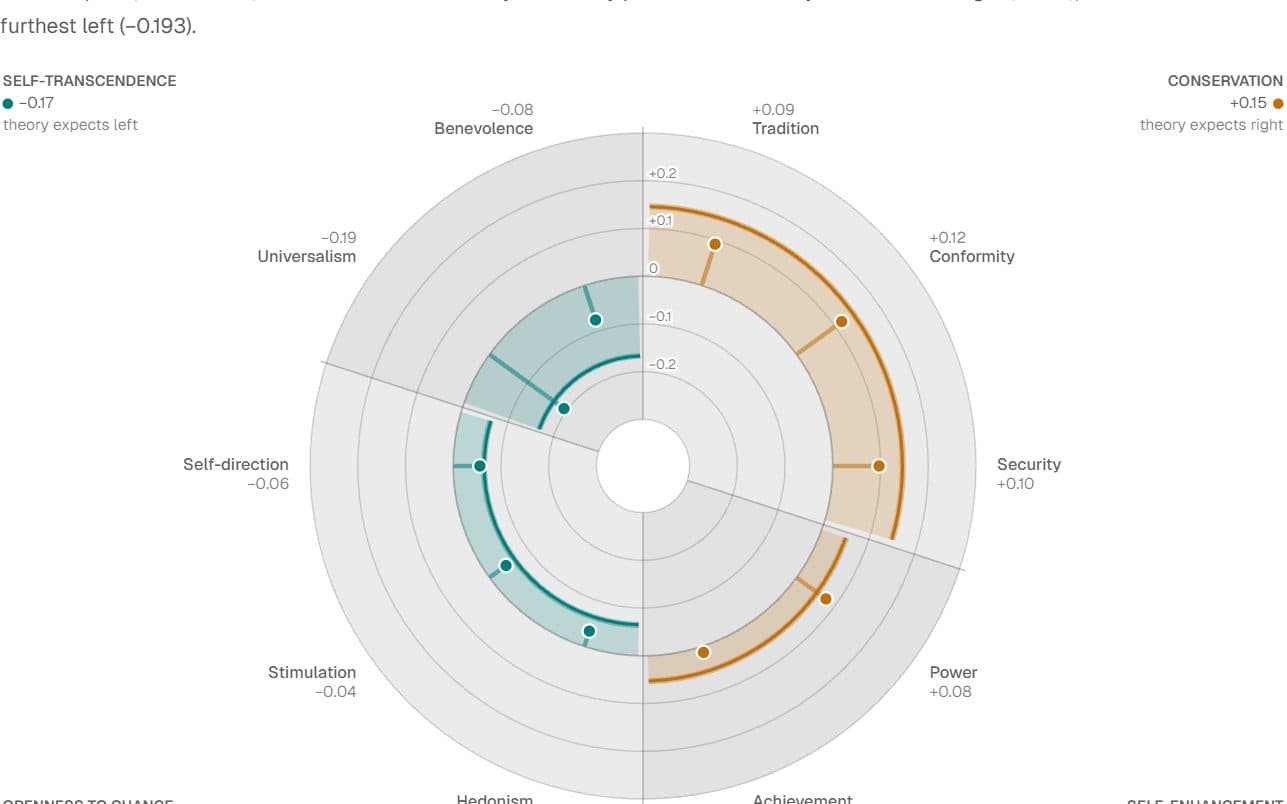
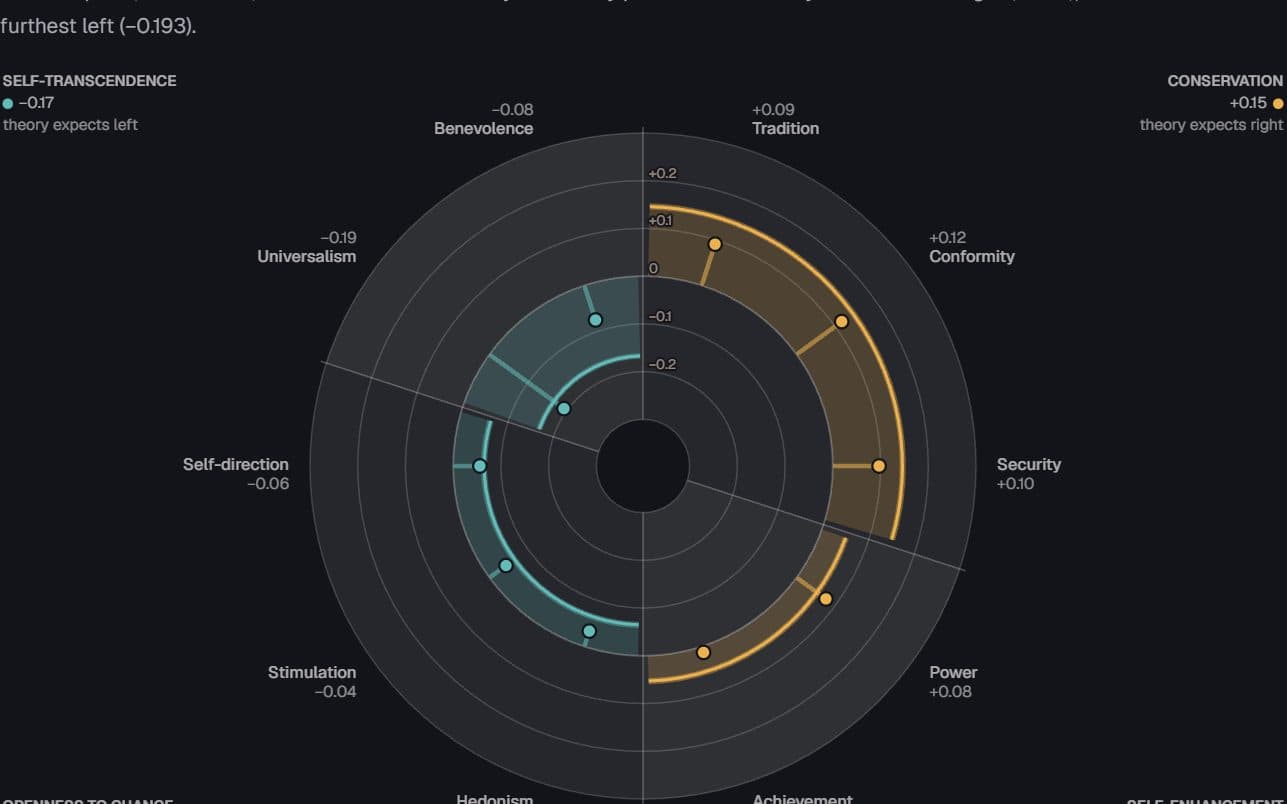
How strongly valuing each of Schwartz’s ten basic values goes with placing oneself further right or left, drawn at the value’s place on the circle.
Pool
Western pool (18 countries): all 10 values lean the way the theory predicts. Conformity leans furthest right (+0.117), Universalism furthest left (−0.193).
- Leans right
- Leans left
- 95% interval
- Zero ring: no association
Each value sits at its place on Schwartz’s circle; only the radii are data. A mark’s distance from the zero ring is the weighted, standardized association between valuing it and placing oneself on the 0 (left) to 10 (right) scale: outward and warm when valuing it more goes with placing oneself further right, inward and teal when it goes with further left. The four shaded sectors are the higher-order axes; each axis is scored from all of its values’ items at once, so its wedge can reach past every one of its values. Hover a sector or a dot, or tab into the wheel and use the arrow keys, for the interval and N.
Slopes shown: Western pool (18 countries) · 14 rows
| Level | Name | Slope | Lower 95% | Upper 95% | N | Theory expects |
|---|---|---|---|---|---|---|
| Higher-order axis | Conservation | 0.15 | 0.14 | 0.15 | 97,280 | right |
| Higher-order axis | Self-enhancement | 0.05 | 0.05 | 0.06 | 97,274 | right |
| Higher-order axis | Openness to change | -0.07 | -0.07 | -0.06 | 97,279 | left |
| Higher-order axis | Self-transcendence | -0.17 | -0.17 | -0.16 | 97,288 | left |
| Basic value | Tradition | 0.09 | 0.09 | 0.1 | 97,224 | right |
| Basic value | Conformity | 0.12 | 0.11 | 0.12 | 97,181 | right |
| Basic value | Security | 0.1 | 0.09 | 0.1 | 97,240 | right |
| Basic value | Power | 0.08 | 0.07 | 0.08 | 97,228 | right |
| Basic value | Achievement | 0.01 | 0.01 | 0.02 | 97,179 | right |
| Basic value | Hedonism | -0.03 | -0.04 | -0.03 | 97,195 | left |
| Basic value | Stimulation | -0.04 | -0.05 | -0.04 | 97,198 | left |
| Basic value | Self-direction | -0.06 | -0.06 | -0.05 | 97,226 | left |
| Basic value | Universalism | -0.19 | -0.2 | -0.19 | 97,271 | left |
| Basic value | Benevolence | -0.08 | -0.08 | -0.07 | 97,205 | left |
Page 1 of 1
Method: per-Schwartz-value weighted standardized LPM slope of left-right on the value (left-right and the value z-scored WITHIN the pool; the standardized slope equals the within-pool correlation, now with a 95% CI). Western pool for the circumplex; Western vs post-communist for the per-region contrast; per-country slopes on all four higher-order axes; per-country weighted mean value positions (saturated WLS predictions with delta-method CIs). Orientation: hv_* MRAT-centred, higher=more important; lr_scale 0=Left..10=Right; signs fixed in advance from Schwartz theory, never from the estimated slope. Weighting: ESS anweight ('weight'); cross-country summaries equal-weight each country. Suppression: per-country slope cells with fewer than 300 interviews (raw rows) dropped; per-country mean cells with effective (Kish) N < 100 dropped. Left–right here is self-placement, not party identification.
European Social Survey (ESS ERIC), rounds 1–10 · PVQ-21 values battery, weighted standardized slopes
Preview
How to read it
Each item sits at its theoretical angle; only the radius is data. The ring halfway out is zero: marks outside it lean toward one pole, marks inside toward the other, and distance from the ring is the size of the association. Shaded sectors are higher-order groupings, drawn as wedges with their own interval band.
When to use it
Values circumplexes, interpersonal circles and any theory that fixes an angular order in advance, with a signed estimate per position.
Watch out for
Do not reorder items by their estimates; the fixed order is the claim being tested. Use a plain radial bar for unsigned magnitudes, and avoid more than a dozen positions, where labels collide.
Data shape & units
items: { key, label, short?, sector, expected?, value?: { estimate, lo?, hi?, n? } }[] in clockwise order; sectors: { key, label, expected?, value?, reference? }[]; a symmetric domain in estimate units.
Missing values
An item without a value keeps its slot and label but draws no mark; a sector without one reads “not estimated”. Intervals appear only when both bounds are supplied and are never folded into a magnitude.
Controls & accessibility
Hover or arrow-key through dots and sectors for the estimate, interval, N and expected pole. Pools and countries redraw the same wheel with a keyed transition; a reference outline keeps a benchmark in view. Below 150px of radius the rim switches to abbreviations and a sector key.
Use the component
Install from the CTZN registry, then pass your prepared rows. Examples below illustrate the component contract.
npx shadcn add @ctzn-viz/circumplex-wheel<CircumplexWheel items={values} sectors={axes} domain={0.3}
poles={{ positive: "right", negative: "left" }}
referenceLabel="West" valueLabel="Slope"
ariaLabel="Values and left–right self-placement" />