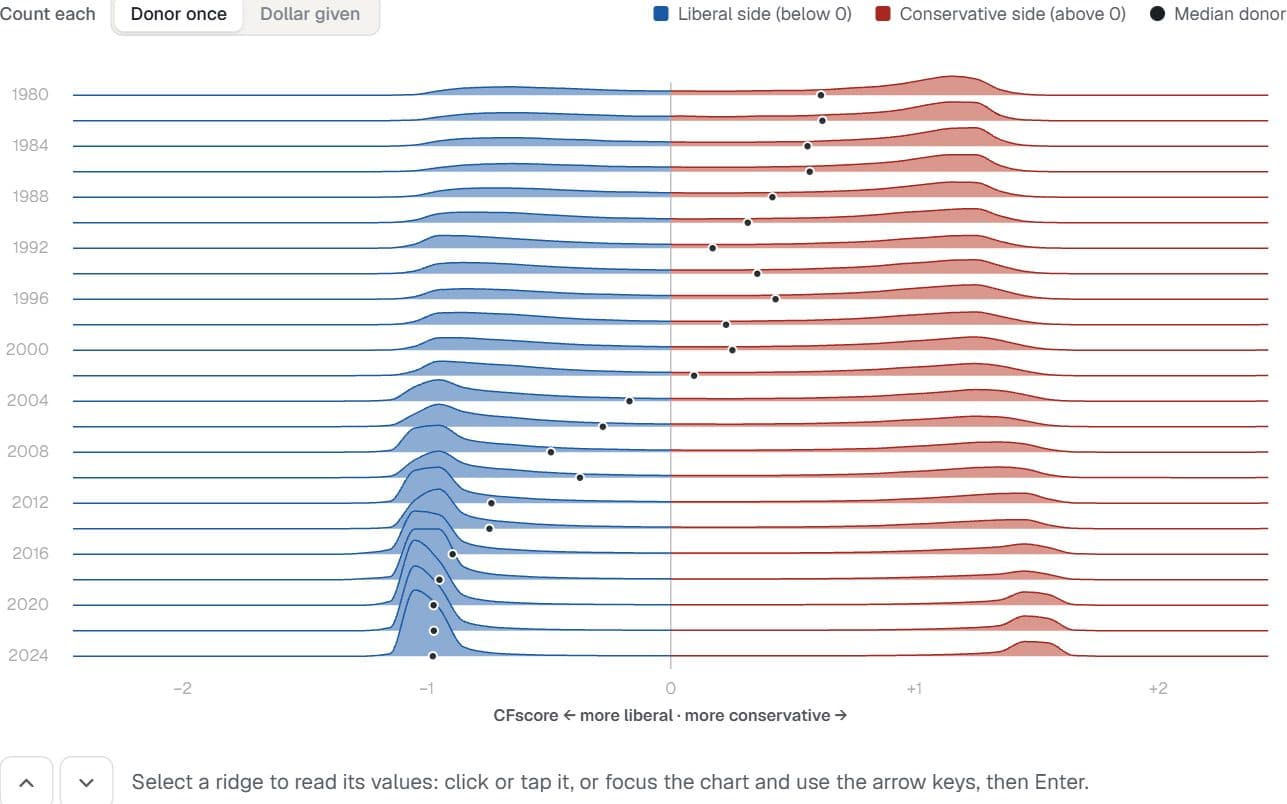
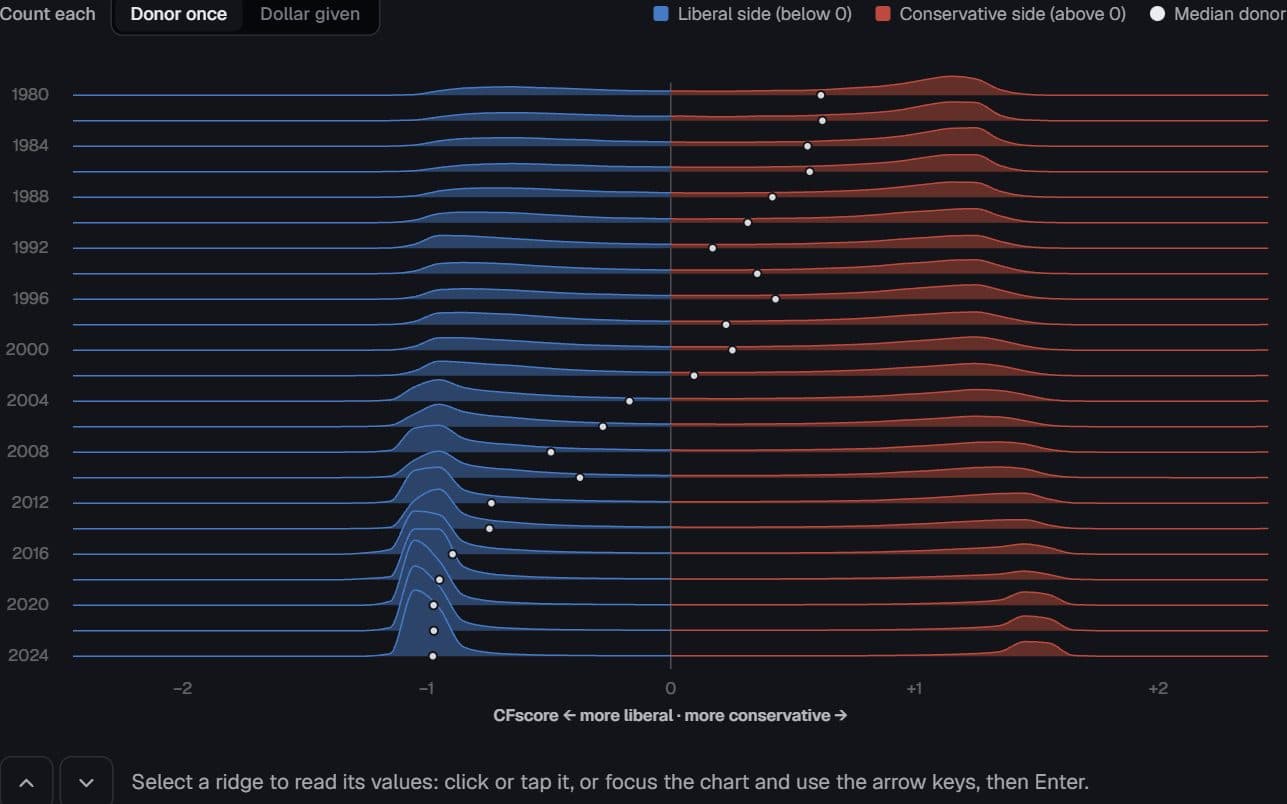
When people change their minds
Which answers persist, and which answers do people move toward at their next interview?
Which statement comes closer to your views, even if neither is exactly right?
86.4% of answer pairs retain the same answer · 45,947 pairs from 12,580 panel respondents
- Answer 1. Government should do more to solve problems
- Answer 2. Government is doing too many things better left to businesses and individuals
Rows: Earlier answer · Columns: Next answer
| Earlier answer | Answer 1 | Answer 2 |
|---|---|---|
| Answer 1 | 88.0%n = 22,349 | 12.0%n = 3,034 |
| Answer 2 | 15.6%n = 3,216 | 84.4%n = 17,348 |
Percentages use only the reported pairs within each earlier-answer row and total 100% apart from rounding. Omitted cells remain missing; these percentages cannot recover their values. Off-diagonal cells represent changed answers. People can contribute more than one pair; these are descriptive pair counts, not independent respondents or population transition probabilities.
Pew Research Center American Trends Panel · captured national-sample aggregates
Reading notes
Consecutive answer pairs can repeat respondents. Counts are descriptive; row percentages use reported pairs only, excluding suppressed cells.
Source & method
Pew Research Center American Trends Panel · captured national-sample aggregates
Retain five outcomes, question/response wording, party × education cells and consecutive-answer panel aggregates. Drop unrelated trend payloads. Percentages stay on 0–100; counts remain answer pairs, not unique people.
Capture provenance
- Source repository / file
- tanstack-chart-gallery / data/15-pew-chart-series.json
- Revision
- 2d90fc478eb39f1a18bd2f7f69cf940c3cf3d212
- Captured
- 2026-09-11
- Source SHA-256
- 956e4dd4314e4c670bfe9e5e3af27196f9f7c22a3697e1d3a3cf3443486f6a5f
- Reuse note
- Aggregated public-facing example from the user-owned source repository. Upstream attribution retained; no new license asserted.