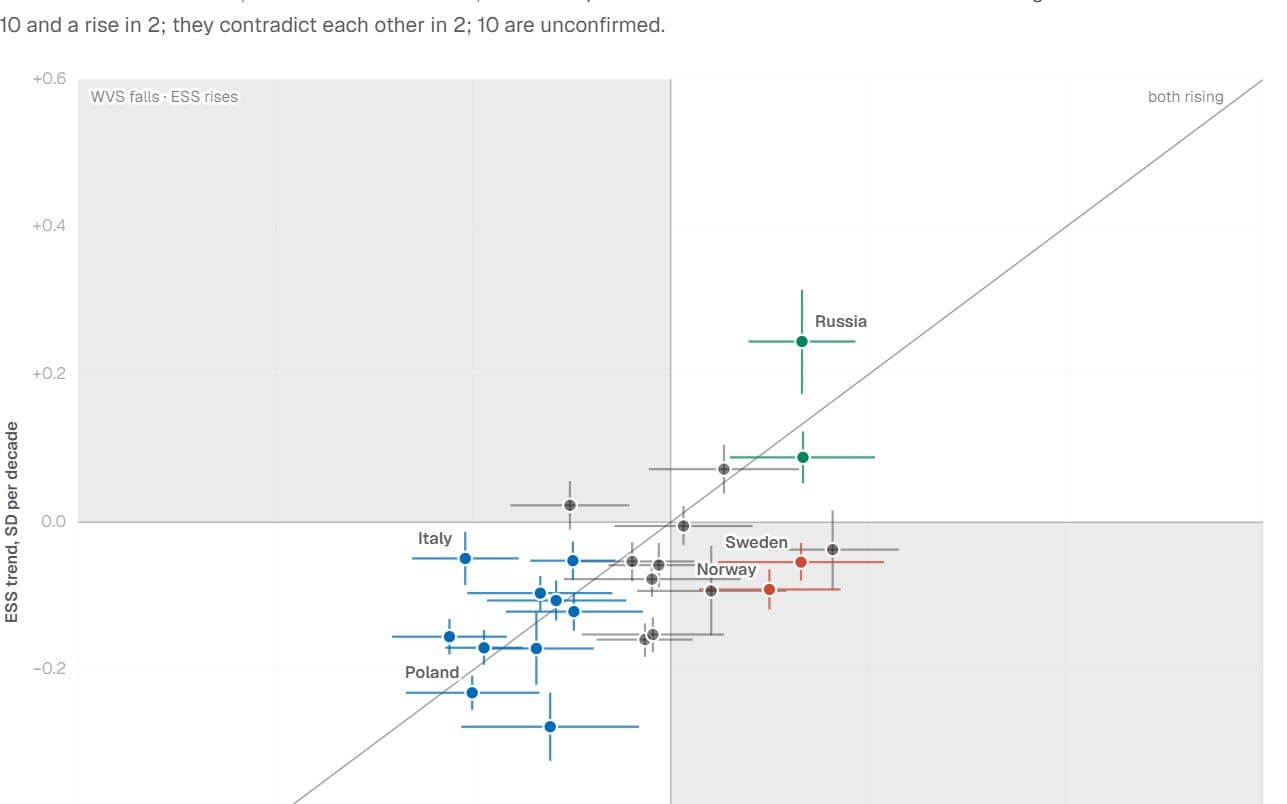
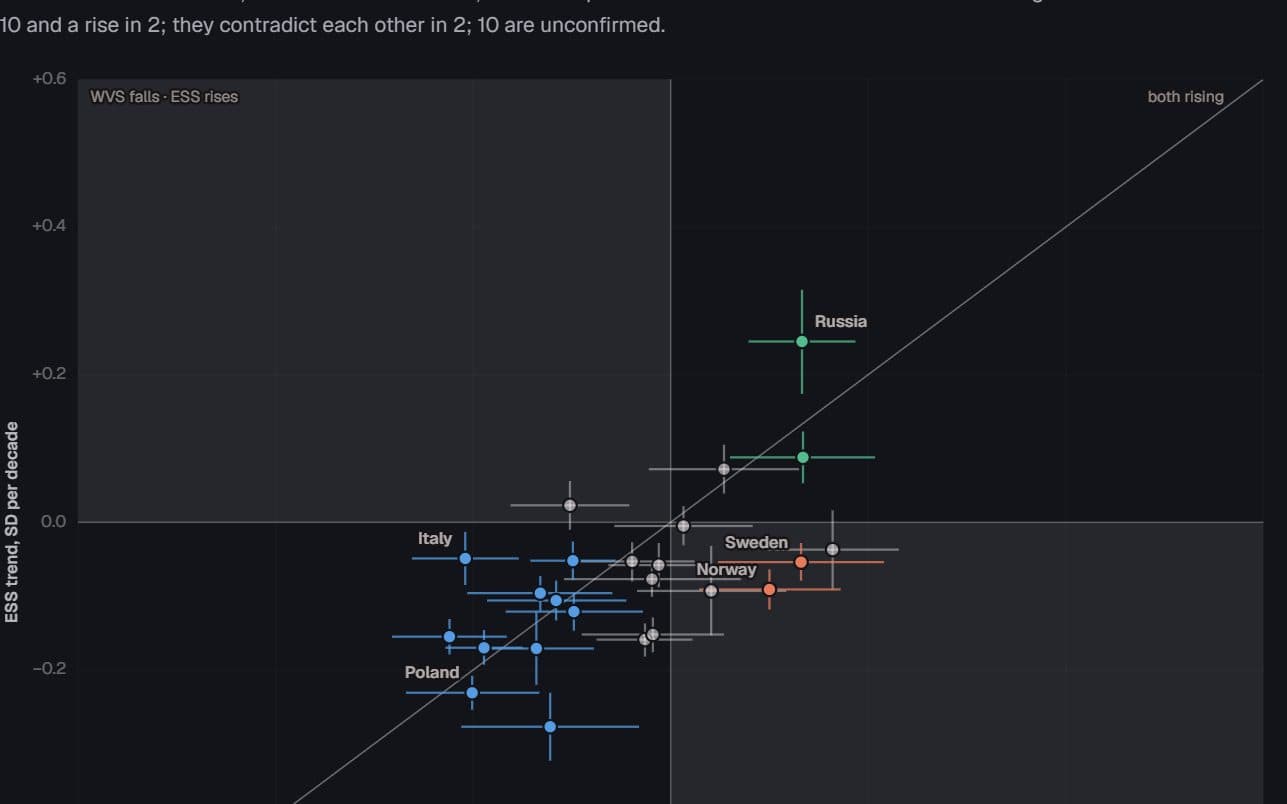
The value circle splits left from right — in the West
Which basic values go with placing yourself on the right or the left, and does the pattern hold in post-communist Europe?
How strongly valuing each of Schwartz’s ten basic values goes with placing oneself further right or left, drawn at the value’s place on the circle.
Western pool (18 countries): all 10 values lean the way the theory predicts. Conformity leans furthest right (+0.117), Universalism furthest left (−0.193).
- Leans right
- Leans left
- 95% interval
- Zero ring: no association
Each value sits at its place on Schwartz’s circle; only the radii are data. A mark’s distance from the zero ring is the weighted, standardized association between valuing it and placing oneself on the 0 (left) to 10 (right) scale: outward and warm when valuing it more goes with placing oneself further right, inward and teal when it goes with further left. The four shaded sectors are the higher-order axes; each axis is scored from all of its values’ items at once, so its wedge can reach past every one of its values. Hover a sector or a dot, or tab into the wheel and use the arrow keys, for the interval and N.
Slopes shown: Western pool (18 countries) · 14 rows
| Level | Name | Slope | Lower 95% | Upper 95% | N | Theory expects |
|---|---|---|---|---|---|---|
| Higher-order axis | Conservation | 0.15 | 0.14 | 0.15 | 97,280 | right |
| Higher-order axis | Self-enhancement | 0.05 | 0.05 | 0.06 | 97,274 | right |
| Higher-order axis | Openness to change | -0.07 | -0.07 | -0.06 | 97,279 | left |
| Higher-order axis | Self-transcendence | -0.17 | -0.17 | -0.16 | 97,288 | left |
| Basic value | Tradition | 0.09 | 0.09 | 0.1 | 97,224 | right |
| Basic value | Conformity | 0.12 | 0.11 | 0.12 | 97,181 | right |
| Basic value | Security | 0.1 | 0.09 | 0.1 | 97,240 | right |
| Basic value | Power | 0.08 | 0.07 | 0.08 | 97,228 | right |
| Basic value | Achievement | 0.01 | 0.01 | 0.02 | 97,179 | right |
| Basic value | Hedonism | -0.03 | -0.04 | -0.03 | 97,195 | left |
| Basic value | Stimulation | -0.04 | -0.05 | -0.04 | 97,198 | left |
| Basic value | Self-direction | -0.06 | -0.06 | -0.05 | 97,226 | left |
| Basic value | Universalism | -0.19 | -0.2 | -0.19 | 97,271 | left |
| Basic value | Benevolence | -0.08 | -0.08 | -0.07 | 97,205 | left |
Method: per-Schwartz-value weighted standardized LPM slope of left-right on the value (left-right and the value z-scored WITHIN the pool; the standardized slope equals the within-pool correlation, now with a 95% CI). Western pool for the circumplex; Western vs post-communist for the per-region contrast; per-country slopes on all four higher-order axes; per-country weighted mean value positions (saturated WLS predictions with delta-method CIs). Orientation: hv_* MRAT-centred, higher=more important; lr_scale 0=Left..10=Right; signs fixed in advance from Schwartz theory, never from the estimated slope. Weighting: ESS anweight ('weight'); cross-country summaries equal-weight each country. Suppression: per-country slope cells with fewer than 300 interviews (raw rows) dropped; per-country mean cells with effective (Kish) N < 100 dropped. Left–right here is self-placement, not party identification.
European Social Survey (ESS ERIC), rounds 1–10 · PVQ-21 values battery, weighted standardized slopes
Reading notes
Slopes are within-pool associations between valuing something and 0–10 left–right self-placement — not party identification, not causal effects. Value-level slopes exist for the Western pool only; post-communist and country views show the four higher-order axes. Country slopes with fewer than 300 interviews are dropped. Angles are theory (Schwartz 1992), not data.
Source & method
European Social Survey (ESS ERIC), rounds 1–10 · PVQ-21 values battery, weighted standardized slopes
Kept the ten per-value standardized slopes of left–right self-placement for the Western pool (estimate, 95% CI, n), the four higher-order axis slopes for the Western and post-communist pools, and every per-country slope on the four axes (39 countries, grouped West / post-communist / other by the source's own country split). Dropped value_slopes_west and axis_region (duplicates of circumplex and axes), country_space and country_strength (mean-position and composite charts not drawn here) and the prose summary facts. Added the canonical Schwartz (1992) ring order and the conventional two-letter value abbreviations: the source has no angles, so every wheel position is theory, not data. A country missing an axis keeps a null slope; none is filled. Numbers are kept at the source's three decimals.
Capture provenance
- box:Politics / book2/chapters/the-schwartz-map/data.json
- Modified 2026-07-01 · SHA-256 ec1da40772aa0fe35c9d603874a08fada1bf4e437734dcf932c170eb1b9a7275
- Captured
- 2026-09-12
- Fixture SHA-256
- 7f0db61e9a3436ad17c3e9188b15b38ca37a7c169ed675ce81397eb9c14f6de5
- Reuse note
- Aggregates of the European Social Survey (ESS ERIC), rounds 1–10, computed by the book's analysis pipeline. ESS data are free for non-commercial use; cite ESS ERIC and each round's data file when reusing.