Ch. 6
Social Trust — The Foundational Divide
In 1972, the General Social Survey began asking a single question: "Generally speaking, would you say that most people can be trusted, or that you can't be too careful in dealing with people?" That year, 46.6% of Americans gave the trusting answer. In 2024, just 24.3% did. The decline is a fixture of the social-science literature — Robert Putnam built Bowling Alone on it; a small library has followed. But the headline number conceals a sharper finding. The trust collapse is not, primarily, a story about Republicans against Democrats. It is a story about who has money and who has a bachelor's degree. And once you account for those, the partisan story turns out to point in the opposite direction from the one the headlines tell.
The half-century arc, three ways
The headline trust series is the one most people have seen. It starts at 46.6% in 1972, falls through the late 1970s, plateaus in the mid-30s through the Clinton years, slips through the 2000s, and drops to 24.3% in 2024. Putnam wrote Bowling Alone with the data through 1998; he saw 39%. He warned that the trend was likely to continue. It did.
What the GSS also has, and what gets cited far less often, is two parallel measures of the same underlying construct. "Most people try to be fair" (fair_rec) and "Most people try to be helpful" (helpful_rec) are asked alongside the canonical trust question. They form a small triangulation, and the agreement among them is itself a finding.
Trust in People
% of US Population Who Believe People Can be Trusted, by Year
The three measures show the same shape but at different magnitudes. Trust fell 22 points over the half-century (47 → 24). The belief that most people try to be fair fell 19 points (60 → 42). The belief that most people try to be helpful fell only 9 points (47 → 38). Trust — the strictest version of the question — has fallen the furthest. Whatever erosion these items together describe, it has hit the most demanding interpretation of social cooperation hardest, and has barely touched the gentler interpretation of personal helpfulness.
For the rest of the chapter we focus on trust_rec, the most-cited and most-declining of the three. The same patterns hold for fair_rec and helpful_rec at smaller magnitudes; the partisan and income breakdowns are essentially identical.
The income-trust relationship
Cross-section against income, and the picture sharpens. In any given year, the highest-income quintile of Americans report roughly twice the rate of generalized trust as the lowest-income quintile. Pooling across all 27 GSS years where the income quintiles are defined, that gap is 27 percentage points wide.
Trust in People
% of US Population Who Believe People Can be Trusted, by Year and Income
There are several plausible explanations for the income gradient and they are not mutually exclusive. Higher-income households are exposed to fewer adverse life experiences in any given year, and adverse experiences erode trust. They live in less heterogeneous neighborhoods where the residents who exist are more likely to be trustworthy on the survey's terms. They have more financial slack to absorb a defection by a stranger. The point of this chapter is not to adjudicate which mechanism dominates, but to note that the gradient is large, persistent, and dwarfs anything party identity does.
The cleanest way to see the magnitudes is the design-corrected pooled cross-section. The chart below pools every GSS year where trust, income, and party are non-missing — 34,760 respondents across 27 years — and shows the weighted percentage trusting in each of the fifteen Income × Party cells.
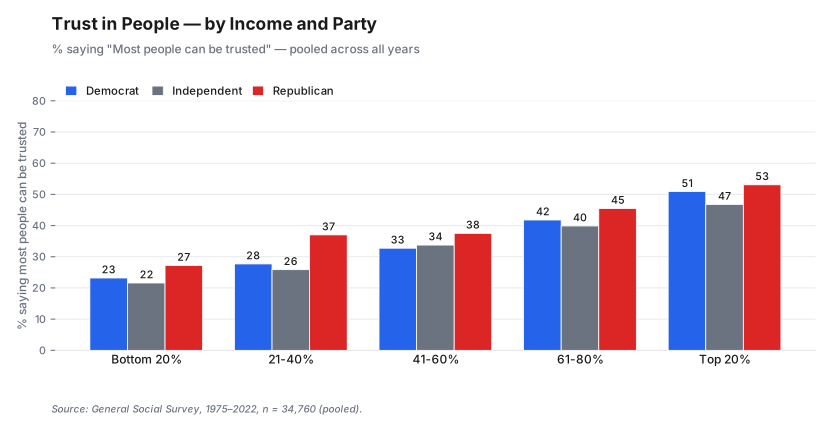
Figure 3 carries two findings.
The income story is the headline. From the bottom quintile (~23% trusting) to the top quintile (~50% trusting), trust roughly doubles — a 27-point gap that has been there for fifty years and shows no sign of closing.
The partisan story is the surprise. The proposal that became this book predicted a moderate partisan gap on trust, with Democrats more trusting. The pooled data does show a moderate partisan gap — but it runs the other direction. Republicans are 4 points more trusting than Democrats in the bottom quintile, 9 points more in the second quintile, and 2–6 points more across the top three quintiles. The asymmetry is not an artifact of any single year. Pooled across half a century, with income held constant, the more-trusting party is the Republican party — by something on the order of 5 percentage points.
Education, income, and trust: disentangling
The one variable that swamps even income is education. College graduates report more trust than non-graduates at every income level, every year, every demographic split.
The two effects, college and high income, are correlated but not identical, and they are both substantial. The 2×2 below collapses every available year into four cells: each respondent classified by whether they have a bachelor's degree (or higher), and whether they sit in the top or bottom 40% of the income distribution. (The middle quintile is dropped from the 2×2 to make the contrast clean.)
| Education · Income | % trusting | n |
|---|---|---|
| No College · Low income | 24.7% | 13,626 |
| No College · High income | 41.1% | 9,476 |
| College · Low income | 51.0% | 1,409 |
| College · High income | 59.0% | 5,480 |
College education adds roughly 18–26 percentage points of trust within each income tier. High income adds roughly 8–16 percentage points within each education tier. The two effects compound: the 24.7% reading at the bottom (no-college, low-income) and the 59.0% at the top (college, high-income) bracket a 34-point gap. That is the 34-point figure cited at the top of this chapter, and it is the single largest demographic gap on social trust visible anywhere in the GSS.
The proposal's framing — "partisan gaps persist within all combinations" — is largely correct, but the direction of the partisan gap is not uniform across cells. The Republicans-more-trusting pattern from Figure 3 holds for the three lower-SES cells but inverts in the highest. Among non-college low-income Americans, trust runs Democrat 24%, Independent 22%, Republican 32% — Republicans 8 points ahead. Among college low-income Americans, the parties are within a point. Among non-college high-income Americans, Republicans are 7 points ahead. But among college high-income Americans — the most-trusting cell on the table — trust runs Democrat 63%, Independent 55%, Republican 60%, with Democrats 3 points ahead of Republicans. The Republican-lead pattern is real for most of the population, but the highest-SES cell goes the other way.
Meritocracy beliefs
There is a related variable in the GSS — getahead_rec, "is hard work the most important factor in getting ahead?" — that flips the pattern in an instructive way. Whereas social trust climbs sharply with income across the population, hard-work belief barely moves with income. And whereas social trust shows a small Republican lead, hard-work belief shows a large Republican lead.
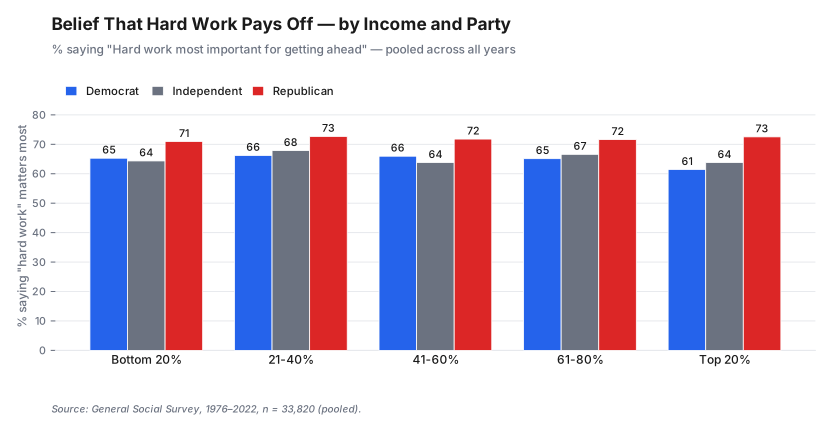
The Republican line is essentially flat: 71% in the bottom quintile, 73% in the top, with no monotonic trend between. Hard-work belief, on the Republican side of the aisle, is invariant to one's actual position in the labor market. The Democratic line is also nearly flat — but slightly negatively sloped: 65% in the bottom quintile, 61% at the top. The richer the Democrat, the less they cite hard work as the engine of mobility.
The proposal flagged this as a striking finding, and the data bears it out. Bottom-20% Republicans (71%) report hard-work belief at a higher rate than top-20% Democrats (61%). The same individual experience — clerical work, modest income, intermittent unemployment, a career below median earnings — is interpreted by a low-income Republican as evidence that hard work pays off, and by a high-income Democrat as evidence that it does not. Ideology does not respond to one's own position in the labor market; if anything, it interprets that position.
This is the most economical example of the partisan-divide thesis the rest of this book is built on. Two Americans look at the same data — their own lives — and draw opposite conclusions. They do not draw those conclusions because they have different data; they draw those conclusions because they read the same data through different ideological frames.
A note on age
The age breakdown of the trust series, while not the chapter's lead, is striking enough to flag. Pooled across all years, trust falls with age in the standard way (younger Americans trust less). But within the under-35 cohort, the recent decline is unusually steep. The 2024 reading for 18–34-year-olds is 7.5%, with a wide confidence interval (n=198, CI 2.4–12.6%) and only one wave of data at that level. The decline is monotonic across the recent series but the magnitude of the 2022→2024 leg should be treated as provisional pending another GSS wave.
If that reading holds in subsequent waves, the under-35 collapse will be the largest single age × time effect anywhere in the GSS. It belongs in Chapter 11, where the temporal analysis lives, not here. We mention it because it complicates the "income gradient is the dominant story" claim — a sufficiently steep decline within young adulthood, especially if it is concentrated in low-income young adults, could reshape the pooled cross-section in ways the half-century pool does not detect.
What the literature said, and what the data adds
Putnam's Bowling Alone established the modern declinist narrative. Built on GSS data through the late 1990s, the book argued that the loss of social capital — the networks, norms, and trust that make democracy work — threatened American civic life. The book's thesis has held up remarkably well; Figure 1's trust panel is essentially the chart he drew, extended by 25 years.
— Robert D. Putnam, Bowling Alone (2000)Americans are now more disconnected from family, friends, neighbors, and democratic structures.
What Putnam emphasized less — and what the data through 2024 makes harder to ignore — is that the decline is not uniform. Pamela Paxton's 1999 American Journal of Sociology article argued that the social-capital decline was real but more modest than Putnam suggested, with components moving in different directions. She was right on both counts. Trust fell sharply; helpfulness barely moved. And cross-sectionally, the variation by class is much larger than the variation over time within class.
The political-science literature on the partisan-gap-on-trust is shorter than the social-capital literature, and our finding — that Republicans report slightly higher generalized trust than Democrats, controlling for income and education — is at odds with some of it. Eric Uslaner's work, in particular, has argued for a small Democratic advantage on generalized trust. The pooled GSS data here, with appropriate weighting, points the other way. We do not claim this overturns the Uslaner result; the difference may be sensitive to the choice of years pooled, the income definition used, or the trust scale (binary vs. continuous). It does, however, mean the conventional reading — Democrats more trusting — is at minimum unstable.
Implications
Three follow naturally from the data.
First, trust is a different kind of variable from the institutional-confidence and political-attitude items in earlier chapters. Confidence in Congress, opinions on welfare, views on race — those track partisan identity tightly, and the gap has widened over fifty years. Generalized trust does not. The variation is dominated by class, especially the class signal that runs through education, with party providing only a small and stable secondary effect.
Second, the partisan-divide framing of this book has limits, and this chapter is one of them. Other chapters return to the familiar pattern: Republicans say one thing, Democrats say another, the gap is wider in 2024 than in 1972. On generalized trust the gap is small, and — outside the highest-SES cell, where Democrats hold a modest lead — runs in the unexpected direction. The signal that does dominate this variable — the diploma divide combined with the income gradient — is the book's other major thread, and on this question it speaks louder than the partisan one.
Third, low social trust travels with low income, low education, and youth. A coalition built on those three demographics will share, on average, a generalized skepticism that anyone — neighbors, institutions, or elites — can be trusted to behave well. A coalition built on the inverse — college, high income, retired — will share, on average, a baseline assumption that strangers are reasonable. Whichever side of the political divide a respondent identifies with, where they sit on those three demographics will predict their level of generalized trust far more accurately than which party they vote for. That is the foundational divide the chapter title points at: not Democrat vs. Republican, but the trusting class vs. the distrusting one.